There is a blue cup on the table. The room remains empty. Then two knocks sound, and it becomes easy to imagine someone by a door just beyond the edge. No door has appeared and nobody has entered: the sound has introduced a possibility into the space the image let us construct.
This page’s scene is an AI-generated illustration paired with a short original synthetic sound. It is not footage of a real place and contains no presence recorded outside the frame. I chose a declared previsualisation to isolate the question: what do we add when we hear a cause we cannot see?
The image stays still
The player plays a five-second file. At the second and third seconds, two damped pulses occur, resembling knocks on a surface. You can listen while looking at the illustration, then return to the same image without starting the audio. The description remains available: two knocks, no voice, no real environment recorded.
Two knocks, an unseen source
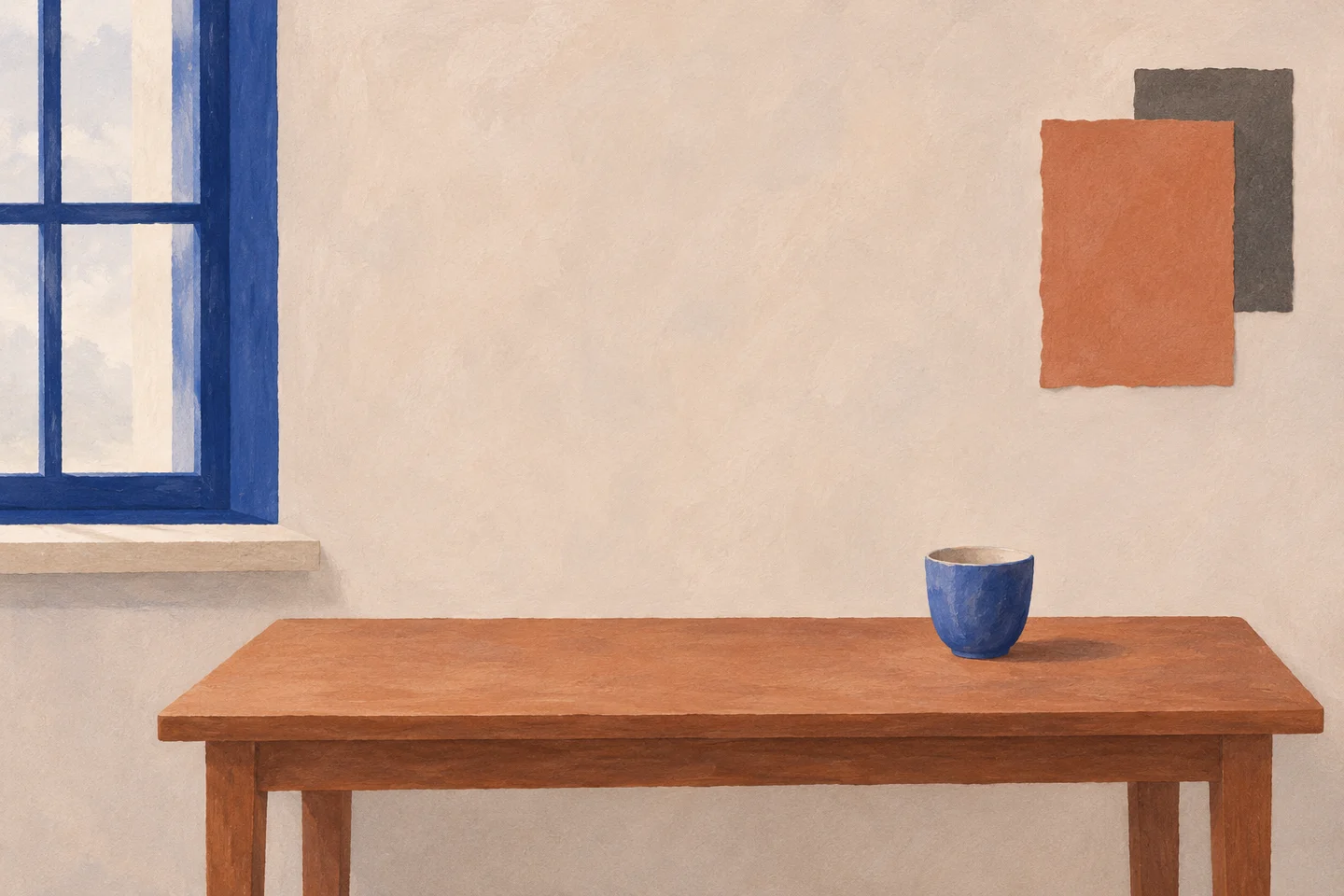
Five seconds: digital silence until 2 s, one damped pulse, another at 3 s, then silence. Synthetic sound, no real source or verified spatial position.
Here the source’s position is not simulated through three-dimensional spatialisation. The file does not demonstrate that the knocks come from a corridor or a specific door. These are hypotheses the scene may encourage, not information hidden in the recording. If we imagine a person, we have added them ourselves.
Offscreen space can begin with a cause we attribute to a sound. The boundary does not disappear. It becomes the limit between what we see and a space we are giving substance to through other clues.
Simply not showing is not enough
A frame always excludes something. But not everything excluded enters the story with the same force. The table probably continues beyond the edge; a noise can make us seek a presence and redirect attention towards that absent part. The work lies in the relationship between the clue and the world the scene proposes, not simply in the amount of space cut away.
Mike Kohler’s article on film sound for the BFI also recalls possibilities opened by recording and editing sound. The reference concerns constructing a soundtrack; it does not certify the interpretation of our example. Here the sound event is deliberately produced and placed, without a real cause to reconstruct.

This distinction matters for documentary footage too. The fact that an image came from a camera does not, on its own, tell us how its soundtrack was assembled. Judging a relationship between sound and place requires production information; an impression of continuity cannot replace it.
The promise can remain open
The two knocks may make us expect an entrance. Keeping the room empty throughout preserves the expectation without resolving it. Adding a hand, showing the door or making a voice answer would change the relationship between clue and confirmation. The image would become another scene even if the cup stayed put.
Not every expectation needs a solution. Leaving the cause uncertain can be a narrative choice, provided uncertainty belongs to the work rather than assigning the material something it does not contain. Our demonstration ends without identifying who supposedly knocked: nobody in its production performed that gesture.
Knowing what we added
A clue can enlarge a scene’s world without proving its existence. This is the margin where narrative works, and where attention is useful when the contexts in which images are used change.
At the end the cup is still on the table. The most crowded part of the room may be the part we never saw. Recognising how we populated it does not weaken the story; it lets us distinguish that strength from evidence.