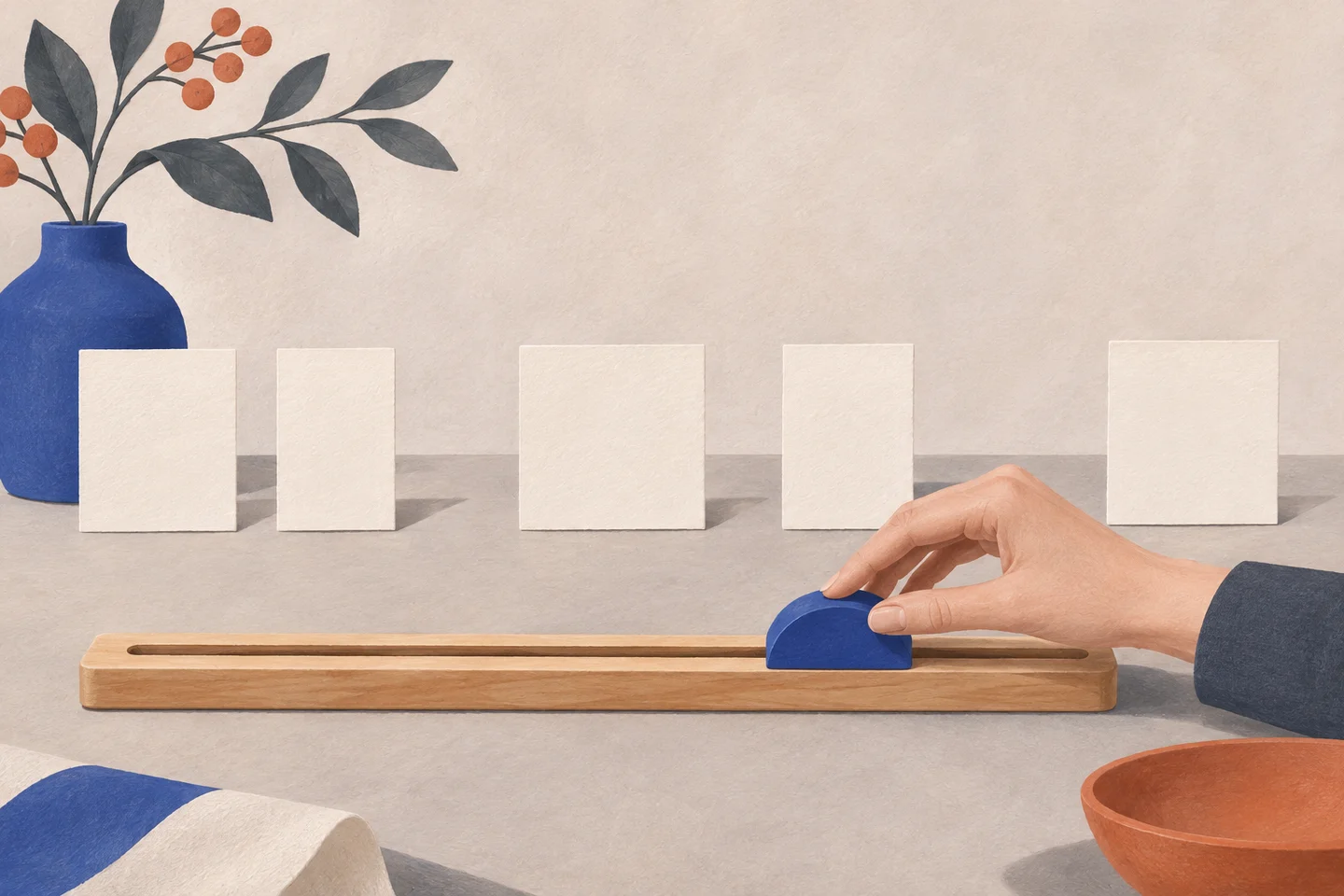
Moving a handle right seems an innocent gesture. In a chronology, though, that small movement decides which moment appears, how much time is skipped and where the hand can stop. The story arrives not only through the records but through the rule connecting a position to an event.
For this essay I prepared five stages of an imaginary archive, on days 0, 1, 4, 10 and 11. These are neither historical events nor data from an existing project. The illustrations show a possible physical control, while the comparison is digital: no installation or ergonomic test is documented.
One step, one record
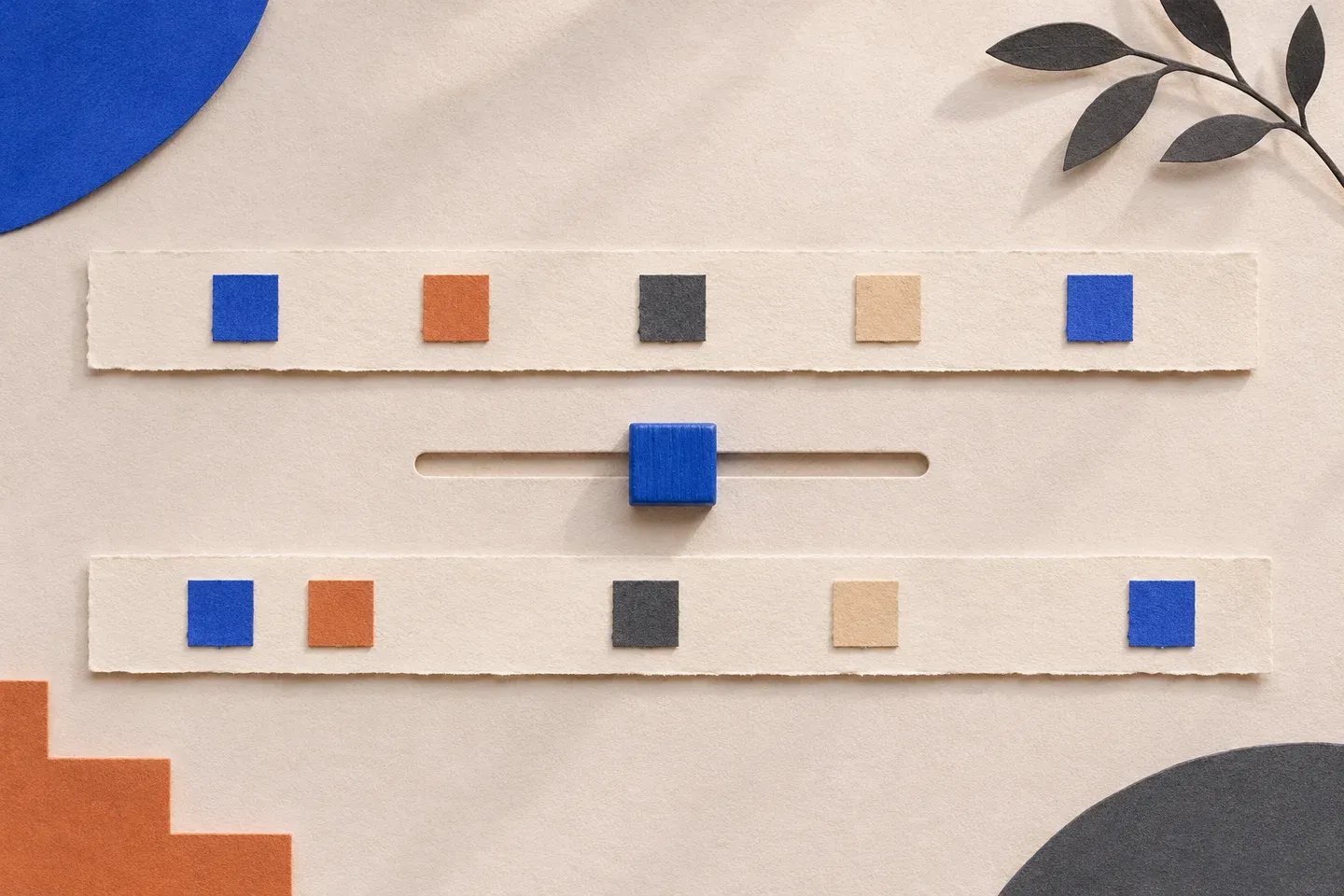
The page’s slider has five discrete positions. Each step selects a stage, regardless of the time since the preceding one. From day 1 to day 4 the hand travels the same distance as from day 10 to day 11. The interface distributes events by index rather than representing elapsed time on a proportional scale.
Five stages, different intervals
Entirely fictional chronology. The slider spaces five indices equally; days are not proportional to travel. The full list remains available.
- Day 0
Gathering material
- Day 1
First selection
- Day 4
Testing the sequence
- Day 10
Reviewing the route
- Day 11
Completing the model
The full list with the same days remains beneath the control. Without JavaScript the chronology remains readable; movement is not required to know its contents. This preserves a useful distinction: exploration can have a particular form without making that form the story’s only access route.
Distance travelled by the gesture does not itself equal distance in time. If we want them to coincide, we must build another scale where a day occupies the same length everywhere. Closely spaced events may then become difficult to select, while empty periods gain space.
Gaps have a form
Equally spaced steps make every event easy to reach, but can diminish the difference between a dense day and a long wait. A proportional line preserves that difference and introduces other reading problems. Neither arrangement returns the past without a choice: it makes it traversable according to a rule.
Before designing the handle, we should therefore decide what the journey should mean. Do we want to compare how often events occur? Follow a succession of testimonies? Return quickly to a document? The answers may require different devices, even when all are called “timelines”.
A hand is not the only way in
In the W3C guide to the slider pattern, name, value and keyboard use form part of the control’s description. The document also notes the need to test use with assistive technology on touch devices. Here I use a native HTML control and keep the full list: this does not amount to testing a physical object or every assistive combination.
The visible value gives both position and day. “Three of five” helps locate us in the control; “day 4” places the stage in the fictional chronology. Merging them into one number would make visitors guess which scale it belonged to.
Stopping is an action too. A physical device could offer friction, detents or continuous travel; these properties would change how a position can be held and revisited. The images let us discuss them but do not measure them. Assessment would require building and testing the device with real people.
The route takes a position
Giving time a form means choosing which differences to make perceptible. Our comparison makes moving between five events easy and leaves their intervals written in the list. It does not claim to make eleven days felt by hand.
The control can become part of the story when its rule stays readable. Otherwise it offers a sense of control while silently deciding what advancing means. The record changes; the question to preserve concerns the stretch we crossed to reach it.