
The gesture is small and the sound arrives at once. We may read it as confirmation, a call for attention or the announcement of something still to finish. Its brevity does not stop it making a promise. If the system sounds as though it has finished when it has only received a command, the misunderstanding has already begun.
Designing a cue therefore requires a decision about the moment to associate it with. Before choosing timbre, I want to name the state it should make recognisable. Starting, completing and requiring attention have different relationships with the person using the system.
Three disclosed associations
For this page I composed three short original synthesised cues, without third-party samples. Labels associate them with start, completion and attention respectively. These are associations designed for comparison: I do not claim the sequences mean those things to everyone hearing them.
Three cues with descriptions
Original synthesised audio, without speech.
Audio players start only on request. Each example has a text description, and playing a cue does not perform its associated action. The example compares durations and patterns; it collects no responses and measures no audience recognition of the cues.
A sound should indicate a state the system can already sustain. A completion cue given too early then requires contradicting a certainty we just produced. An appealing timbre does not repair this temporal inconsistency.
The same state through another route
Meaning must remain available to someone who cannot hear, uses a muted device or is in an environment where the cue gets lost. The sample’s labels are present before playback. A real interface would need a clear correspondence between gesture, written state and optional cue.
The W3C criterion on use of colour requires information not to depend solely on colour. Sound raises a parallel design question here: which meaning stays readable when one channel is unavailable?
The analogy does not turn that criterion into a technical audio rule. It checks a concrete choice: not entrusting the entire distinction between states to whichever difference I most enjoy designing. The word “Completed” may be less seductive than a small chord, but keeps working when the chord does not arrive.
The cost of interruption
A cue useful once may become intrusive when repeated often. Frequency of use therefore belongs to the design as much as file duration. If every ordinary gesture demands acoustic attention, genuinely important events must compete with a conversation the device keeps initiating by itself.
Disabling sounds requires the interface to retain its meaning. It should not force a choice between working quietly and knowing what is happening. Volume also depends on context and device: a short file does not guarantee discreet listening in every setting.
For the same reason I do not start examples while the reader scrolls. The article discusses cues; it does not need to impose one to be read. Choosing to listen belongs to the comparison and leaves the reader in control of their environment.
A small vocabulary
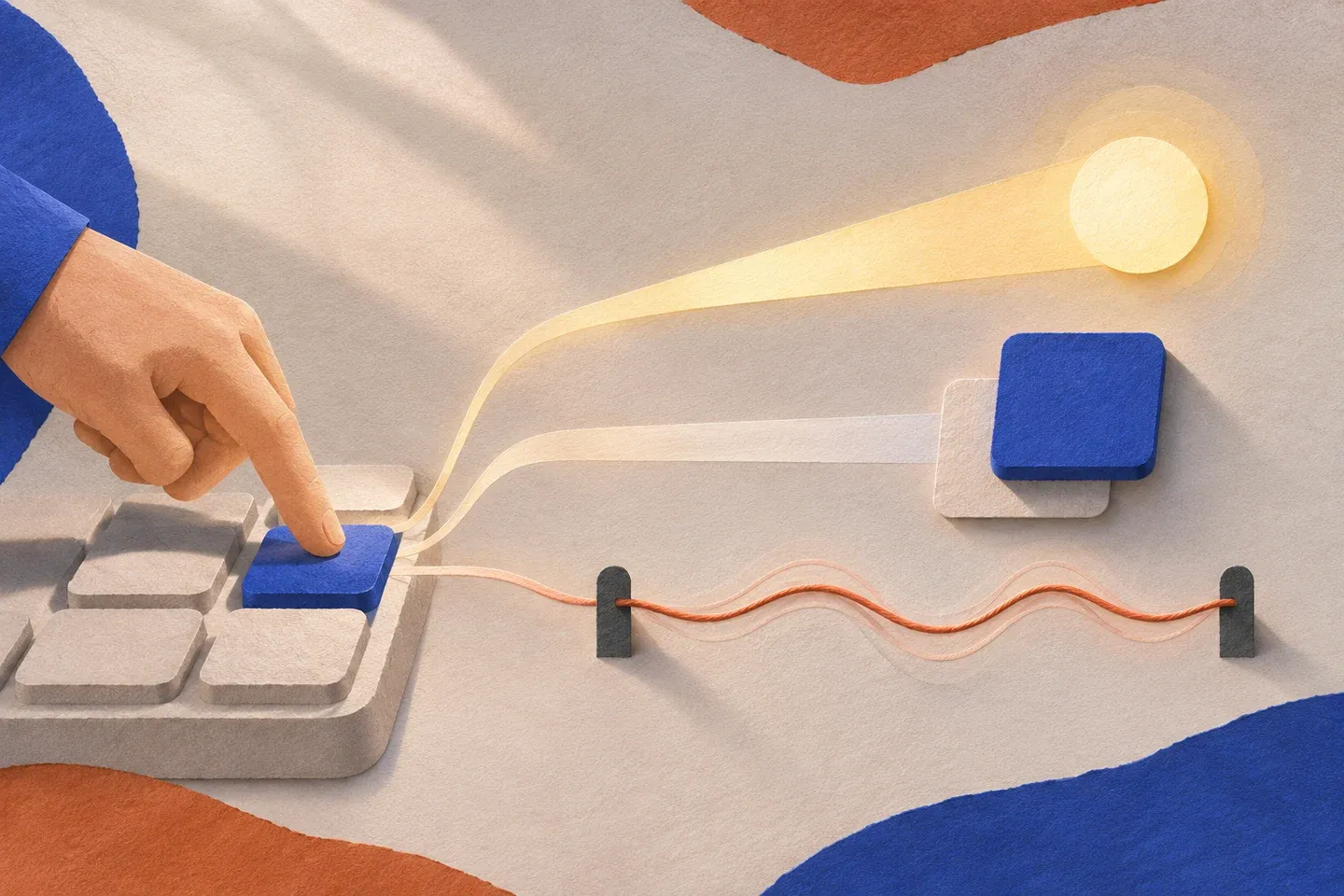
The AI-generated illustrations place a button beside light, form and an imagined vibration. They do not show a built device or an actual tactile trial. The available material consists of the three audio files and their descriptions.
In a concrete system I would seek a few associations distinct enough to be learned, maintained and, if necessary, explained. Adding a sound for every variation enriches the catalogue and may make use more demanding. A complex system does not oblige us to transfer every difference into the sonic environment.
Useful feedback makes what happened recognisable without demanding more attention than the event it accompanies. The cue ends quickly. Responsibility for its promise remains in the interface’s behaviour.