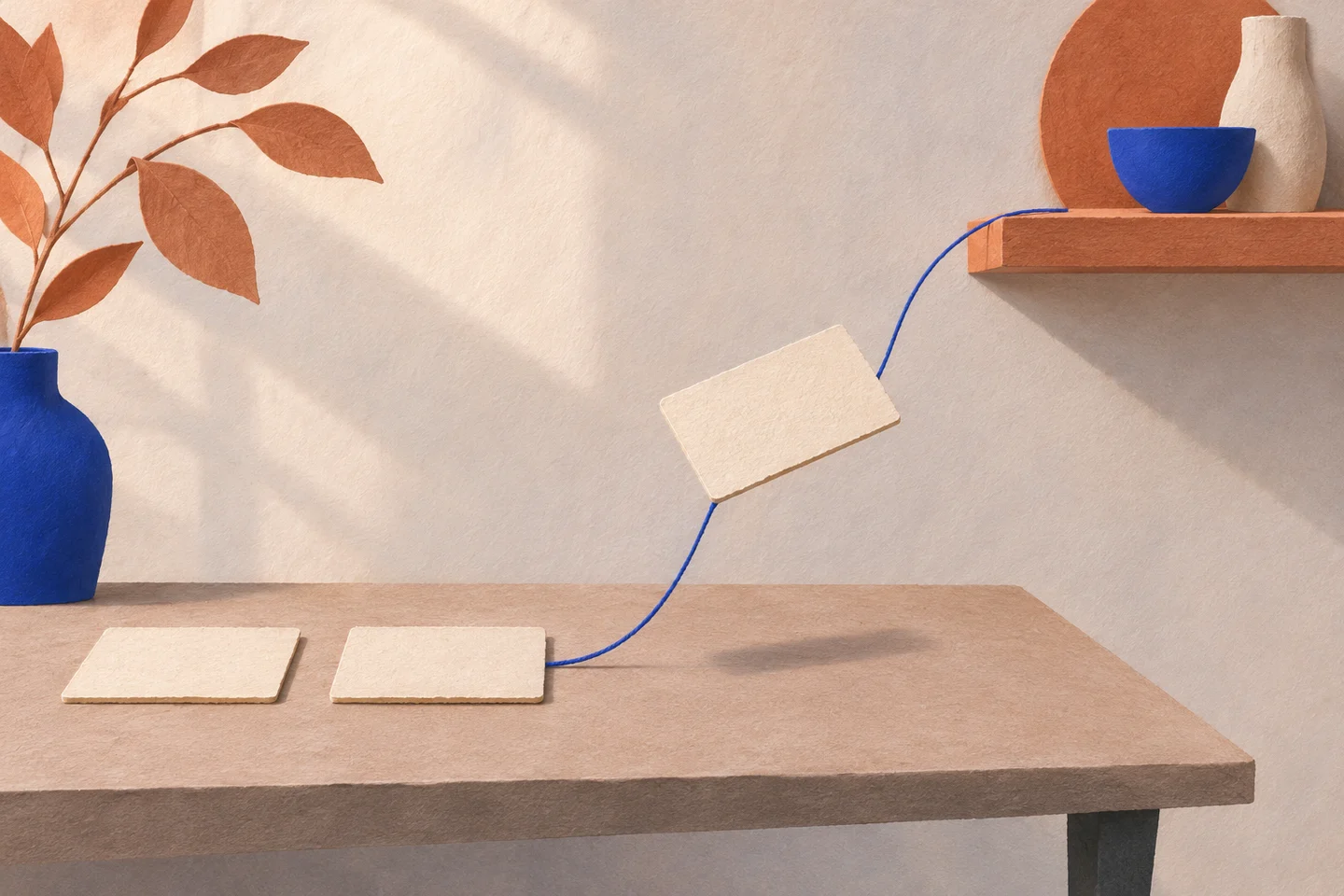
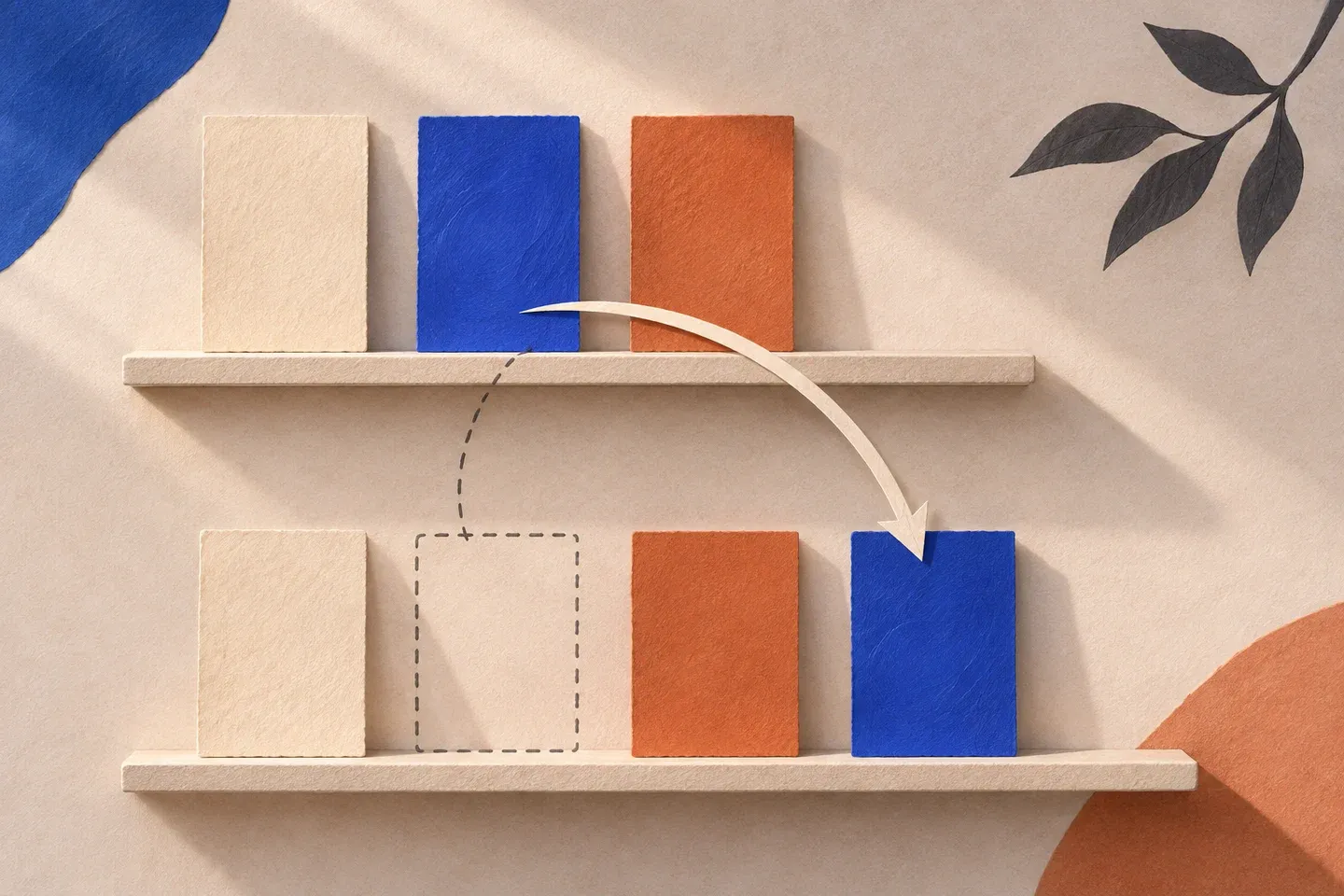
A card disappears from the row and reappears among the collected cards. The result is understandable: it was here, and now it is there. Yet an instant change may leave a smaller question open. Has the same element moved, or has a new one taken its place?
Movement can make this continuity visible. It can also bury it beneath an unnecessary performance, long enough to make us forget the command we just gave. Its usefulness depends on the relationship it preserves during the passage.
Keeping what changes recognisable
This page’s example starts with three tiles and a collection area. One command moves a tile; another restores the initial arrangement. The comparison offers an instant change and a short transition of 180 milliseconds. The tile’s colour, name and destination stay the same, keeping the position change as the main issue.
Following a tile
Collection
The trajectory connects two places without adding a separate explanation. But a reader arriving after the movement still finds a complete result: the tile in the collection and a written status. The animation does not hold essential information that disappears when its journey ends.
A useful transition leaves a comprehensible trace even when nobody watches it happen. This is a more demanding criterion than making a command feel pleasant. It asks us to read the final state as a page in its own right.
Time belongs to the person using the page
W3C’s guidance on animation from interactions provides for disabling non-essential motion. The example respects the reduced-motion preference while preserving the change of state.
That preference should not produce a less understandable version. I can replace the journey with a stable position, updated wording and a command with an explicit meaning. If a system needs movement to explain where something has gone, perhaps its destination deserves further work.
Even someone who has not requested reduced motion may be in a hurry, switch tabs or use the keyboard while looking elsewhere. A transition tied to an action must tolerate these timings. Reset should not have to wait for a little choreography, and a second command should not accumulate movements left in a queue.
Following a relationship
I do not consider 180 milliseconds suitable for every interface. Here it is a local choice, read alongside the distance travelled and the simplicity of the scene. A complex rearrangement might need another solution, including giving up animation altogether.
The two AI-generated illustrations stage the card, the thread of its passage and the place left empty. The exact example happens in the document instead: it does not measure an audience’s understanding.
Movement earns its place when it makes a relationship easier to follow. Once the transition is over, the page needs to be able to stand still. That is where the reader continues their own work.