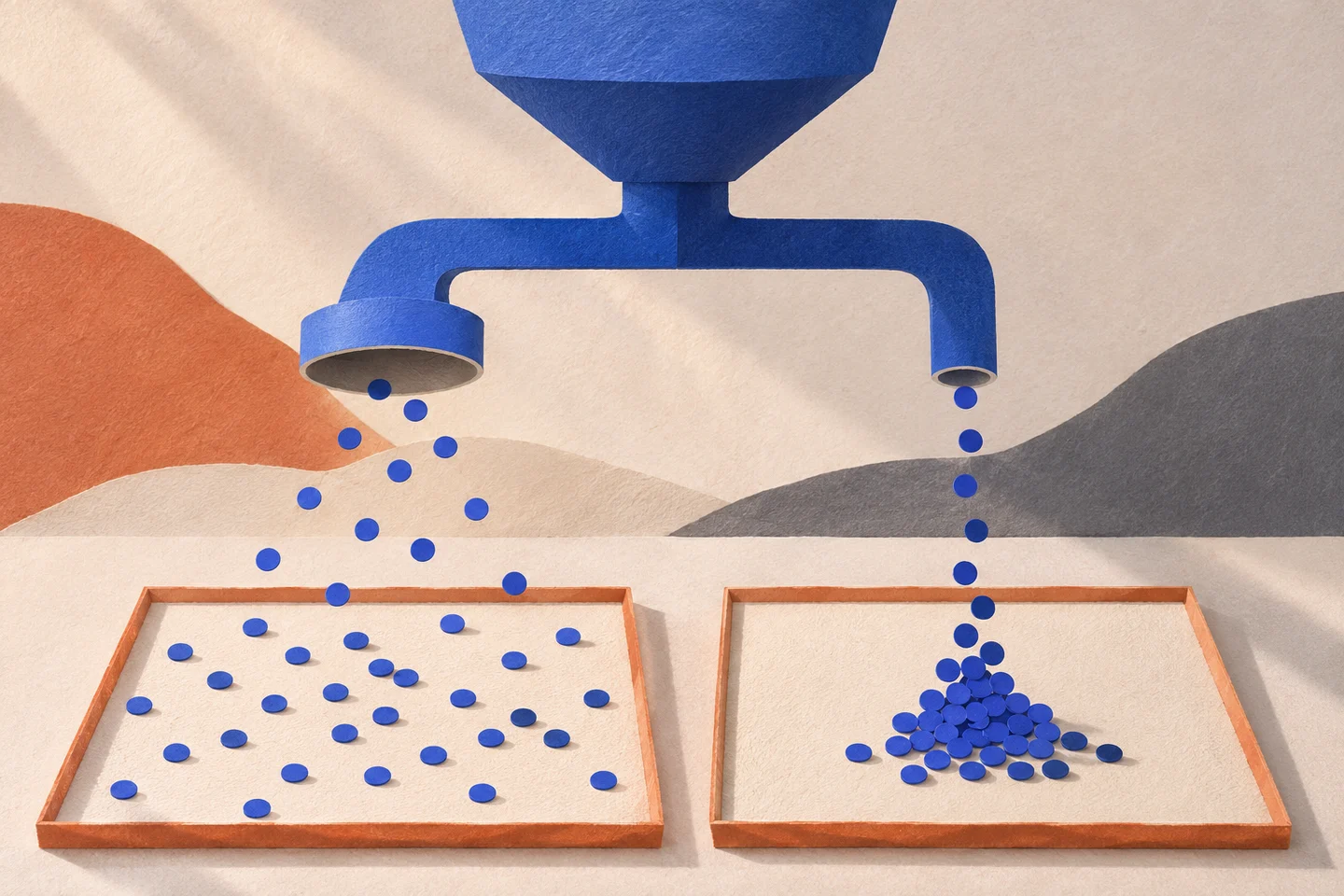
Points appear in positions I have not chosen individually. Yet none leaves the rectangle and all obey the planned quantity. Surprise already occupies a bounded field. Forgetting that field can make a result seem much freer than the procedure that produced it.
To examine the relationship I prepared two drawings with forty points each. Their starting sequence is the same; what changes is the transformation placing the values in space. One lets points occupy the field without an introduced preference towards the centre; the other concentrates them towards the middle.
Returning to the same beginning
An initial number, the seed, allows a sequence to be reconstructed when algorithm and parameters stay the same. The p5.js documentation for randomSeed presents this property. This page uses its own generator: the seed’s value does not identify a drawing by itself outside that procedure.
One seed, two distributions
The command recalculates both fields from the chosen number. Repeating a value returns the same points; changing it offers another sequence for comparison. Without JavaScript, the initial example with seed 7 remains readable, alongside the explanation of both transformations.
The seed preserves a starting point; the rule decides what it can become. Returning to a work therefore requires keeping both, together with the other choices contributing to the result. A number noted without its program may be a very precise memory of something I can no longer reconstruct.
Distribution is a visual choice
The concentrated field derives from transformed coordinates rather than manually discarding less interesting points. Its density towards the centre belongs to the procedure. Subsequent selection would produce another history of the result, which should be kept separately.
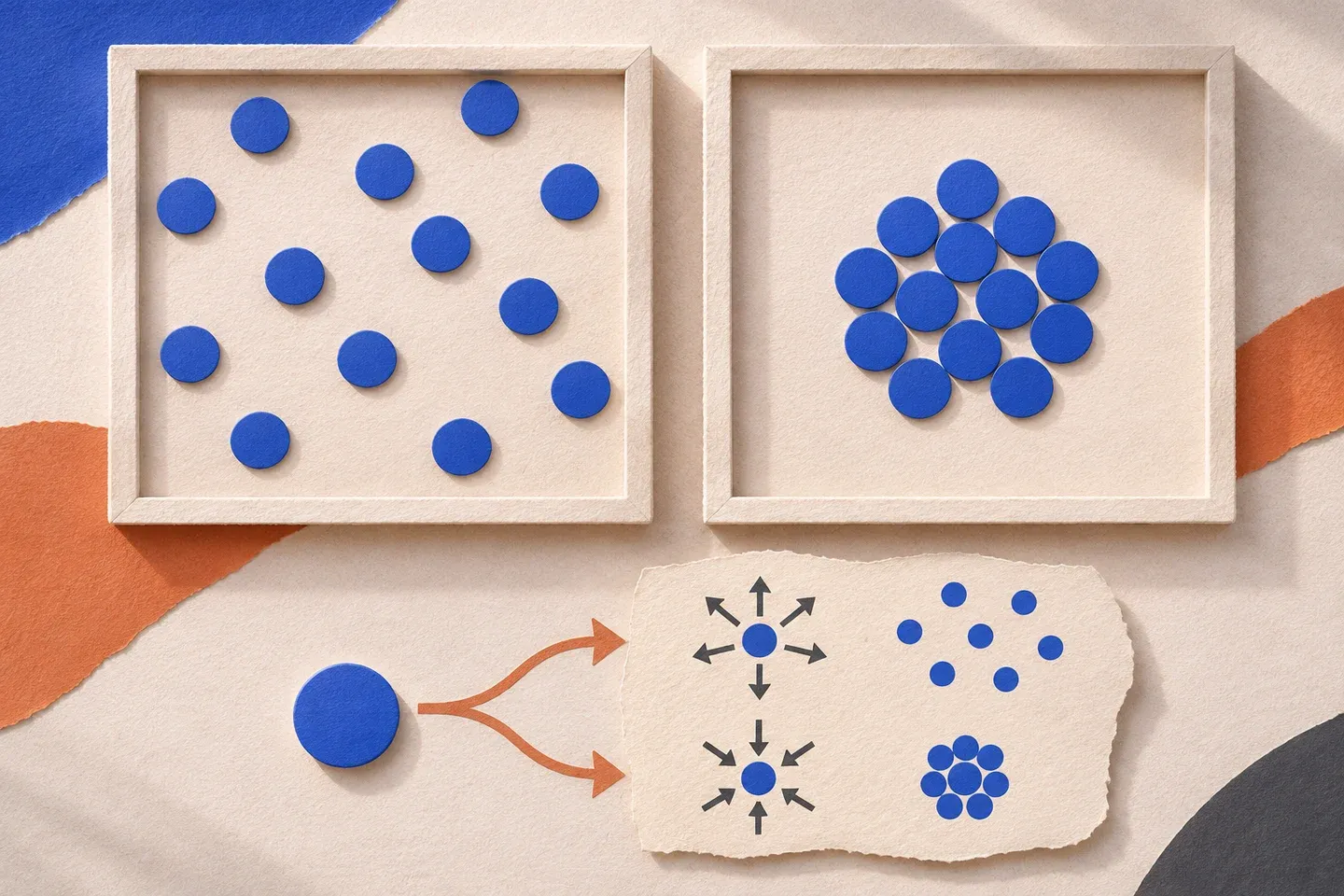
Forty points still form a small sample. One composition does not demonstrate all of the generator’s statistical properties and may show local gaps or clusters. The sample reveals the effect of a disclosed transformation rather than certifying a randomness source or cryptographic quality.
The AI-generated illustrations materialise the container and the opening guiding the fall. They are metaphors for a constraint. Exact positions belong to the drawings built in the document and are not derived from the illustrative images.
Documenting the search
During generative research I would keep some results close to the selected one. This helps establish whether a quality belongs to the procedure or to a particularly fortunate specimen. Showing only the best composition can make a permissive distribution look like a system that always produces the same clarity.
This note concerns parameters; the essay on who decides the final form instead follows responsibility for choices and selection. The two problems meet when an output receives its place in the archive.
Designing chance means making visible the constraints worth preserving. A new seed may continue to surprise. That surprise becomes comparable because we know which doors stayed open and which we had already closed in the code.