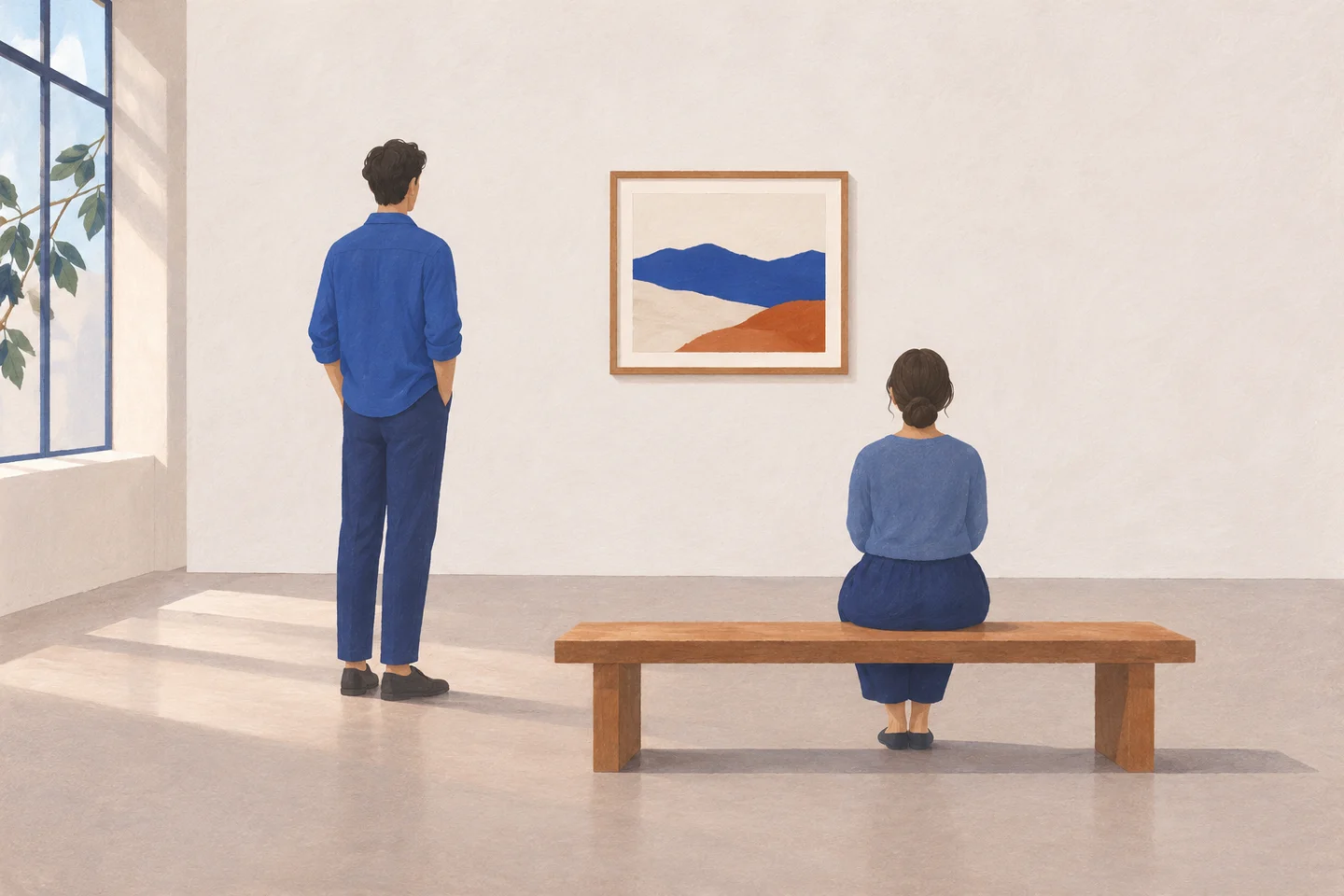
On the plan, the label is close to the work. A small rectangle beneath another seems to settle the relationship. But a plan does not have to bend down, step back to focus or wait for another visitor to move. The body enters later, when some decisions have already become walls and furniture.
For this essay I built an imaginary scenario: an object in a display case, a wall with an image, a seat. The illustrations are AI-generated previsualisations. They document neither an exhibition I visited nor a tested installation. They make an arrangement open to discussion before we call it an experience.
The point from which we look
Looking from a seated position can change what a case lets us see. A rim that seems thin from above can conceal part of the object from a lower point. The collection has not changed. Access to one part of it has changed, and that change may remain invisible to someone checking the design only from the most comfortable position.
Two sightlines
- Higher viewpoint
- Lower viewpoint
- Obstacle
Conceptual section without dimensions: two sightlines lead towards the object; the lower one meets the rim. This is not a regulatory or anthropometric assessment.
The diagram relates two sightlines and an obstacle without anthropometric measurements or construction dimensions. It cannot certify the accessibility of a real space. It helps us formulate a check: from which positions does the rim stop being a detail of the furniture and become part of the scene that hides the content?
In the Smithsonian Guidelines for Accessible Exhibition Design, the overview on furniture and lighting explicitly considers visibility and reflections for seated and standing people. This is an institutional reference to the problem, not an Italian regulation this page claims to apply. What matters here is the choice to include more viewpoints in the design question from the outset.
Reading requires a position
The same applies to text. Large lettering can still demand an awkward posture: too close to the floor, beyond reflective glass or where stopping interrupts circulation. If visitors must choose between reading and keeping the way clear, placement is taking part in selecting what will be read.
Content can be present and still be difficult to reach. Adding information does not automatically correct the relationship between text and those trying to encounter it. Sometimes the work means removing an obstacle, making a viewing distance practicable or offering another form of access.
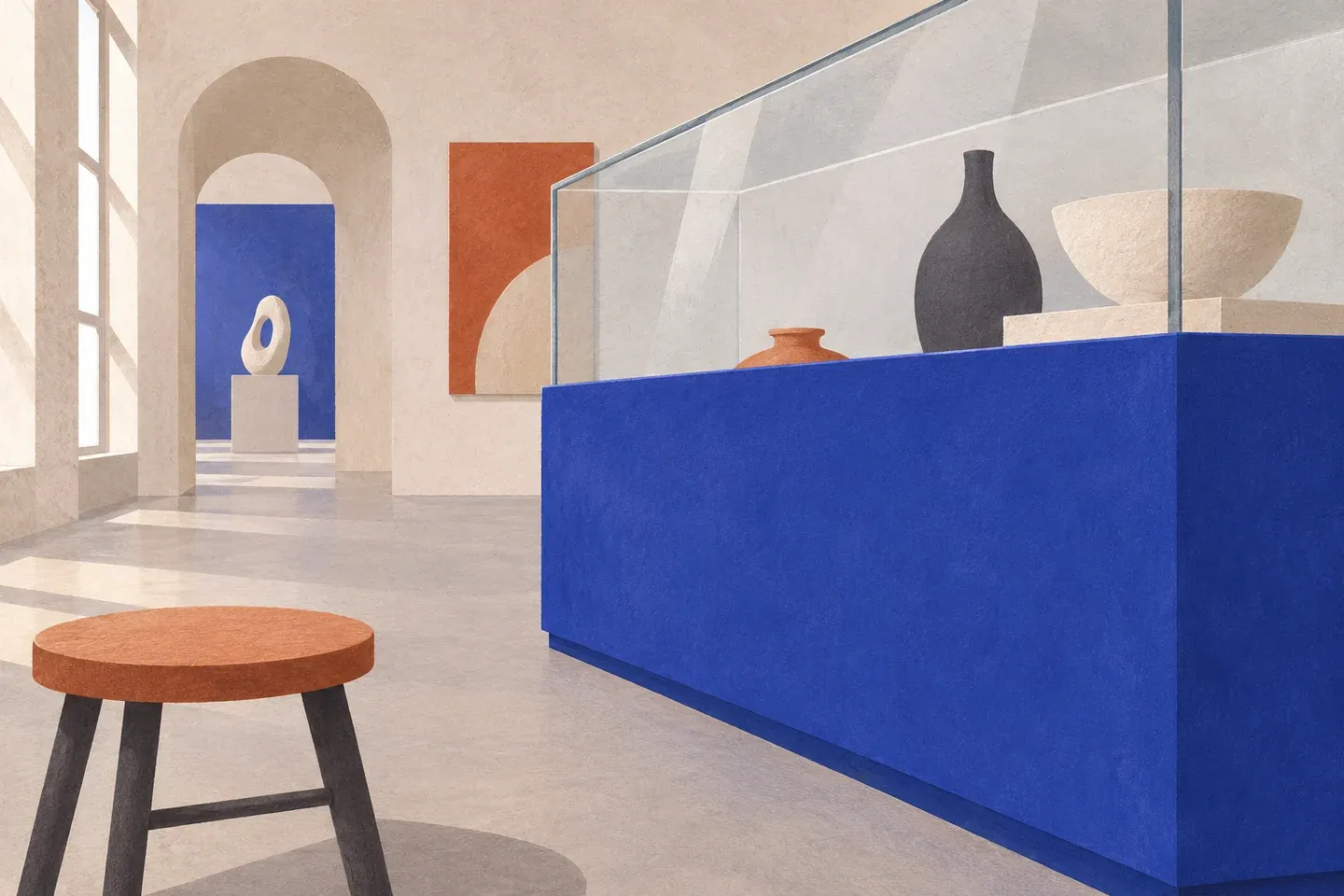
An audio description and a tactile reproduction, where appropriate, have requirements of their own. They are not accessories to place wherever space remains. They need locations, instructions and conditions of use that must enter the same design. No single illustration can verify all those conditions.
The seat changes the story
A bench introduces a possible duration. It lets people stop without standing throughout their observation; it can also direct attention towards a single part of the room. Its presence is therefore not innocent in narrative terms. It makes a pause more habitable while assigning it a place.
This does not mean prescribing a compulsory route or turning every room into a sequence of instructions. An exhibition can leave people free to approach and return. To preserve that freedom, it must ask which possibilities are practicable and for whom: many directions on paper are of little use if only one offers space to stop.
In our scenario, the bench does not solve the overly high case. The problems remain distinct. It is easy to make a visible gesture of care stand in for the whole installation; it is more useful to check, element by element, which action it actually permits.
Returning to space
The plan remains essential, but it is not enough as a final test. Sections, models and assessments in space are needed, involving people with different requirements rather than treating the designer’s body as everyone else’s implicit measure. This page stops at the conceptual model: we have not carried out those assessments or anticipated their outcome.
The visitor’s position is part of the form of the content. A room can announce openness while effectively requiring a single posture. The work begins when that implied body stops seeming natural and becomes a choice to discuss.