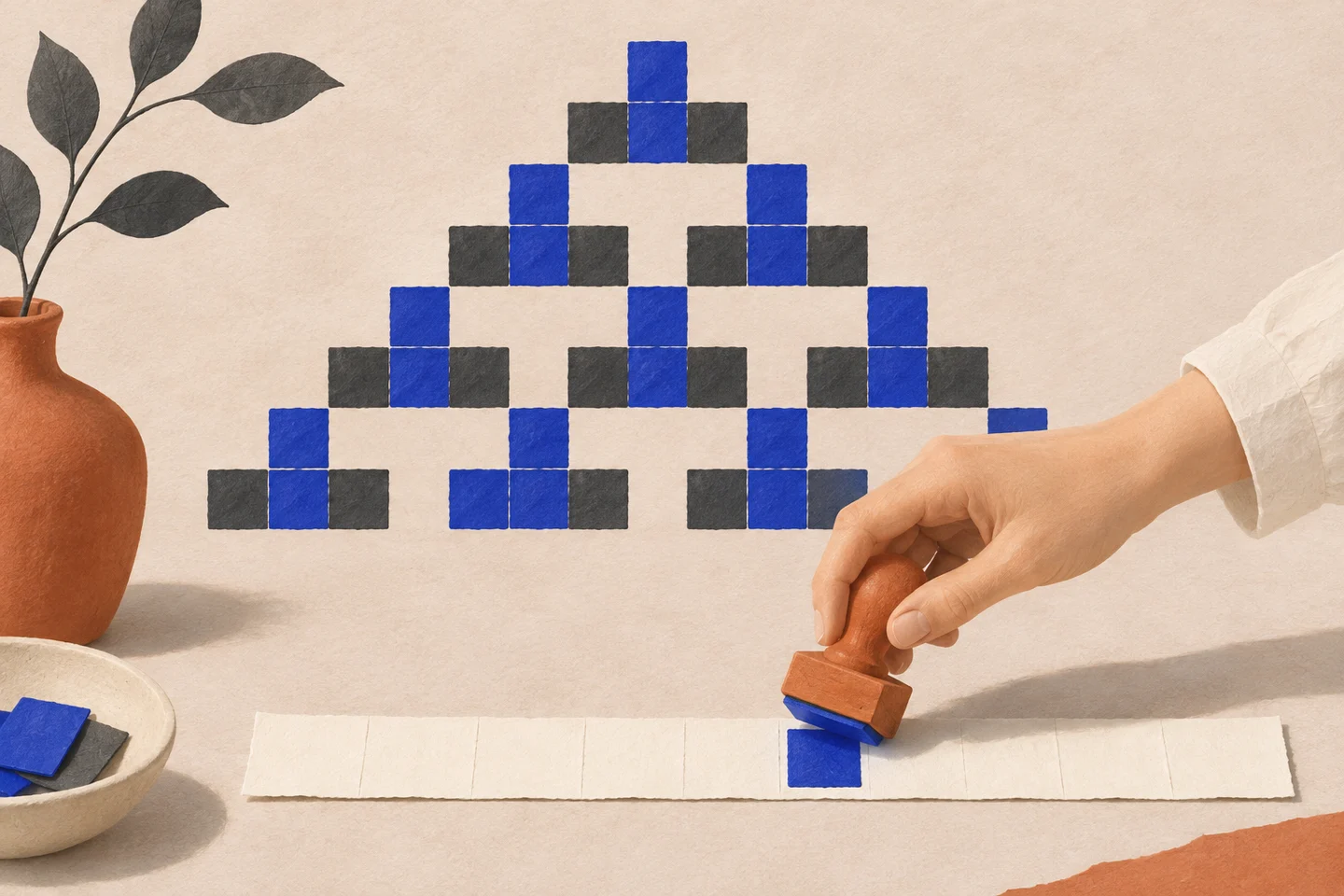
A cell looks at itself and its two neighbours. From these three squares it derives its next state. The task is small; the sheet forming below, row after row, can become much harder to describe. Complexity appears without every detail having been drawn in advance.
For this workshop I built an elementary automaton using rule 30. It begins with a single active cell in the middle of a row of forty-one. Beyond the boundary, cells remain inactive; we observe twenty steps. These declared, finite conditions let us return to the same result instead of asking the word “generative” to do all the work.
Eight cases suffice
The three observed cells can form eight combinations. The rule assigns an output to each: from 111 to 000, the output sequence is 00011110. Each new row is calculated from the entire previous row, without using newly updated cells. Changing that calculation order would produce a different system.
One rule, twenty steps
41 cells, rule 30, one active cell in the centre; zero beyond the edges. Each row derives from the entire preceding row. No randomness or automatic start.
Read every row: 1 active, 0 inactive
000000000000000000001000000000000000000000000000000000000000111000000000000000000000000000000000000011001000000000000000000000000000000000001101111000000000000000000000000000000000110010001000000000000000000000000000000011011110111000000000000000000000000000001100100001001000000000000000000000000000110111100111111000000000000000000000000011001000111000001000000000000000000000001101111011001000111000000000000000000000110010000101111011001000000000000000000011011110011010000101111000000000000000001100100011100110011010001000000000000000110111101100111011100110111000000000000011001000010111000100111001001000000000001101111001101001011111001111111000000000110010001110011110100001110000001000000011011110110011100001100110010000111000001100100001011100100110111011110011001000110111100110100111111001000100011101111011001000111001111000001111011101100010001
The control advances one step at a time; reset returns to the initial display. There is no automatic start, and the complete evolution is also available as a text list. Wolfram’s Atlas of Simple Programs presents rule 30 and other examples of its evolution. Our grid is calculated here with its own dimensions and boundaries, rather than importing an image from the atlas.
A short rule can need many steps to show its consequences. We need not give the cells intentions. Each follows the same table; the whole preserves the effects of preceding responses.
Seeing time in the sheet
In the static image all rows are present together. In the system, one comes before another. The vertical coordinate records a succession: moving down a row means applying the rule again, not moving to another part of the same instant.
The step control makes this difference visible. We can stop where a band divides and ask which three squares produced each output. Predicting the whole pattern is not always easy, but every update can be reconstructed. The opacity of the whole does not require its procedure to become mysterious too.
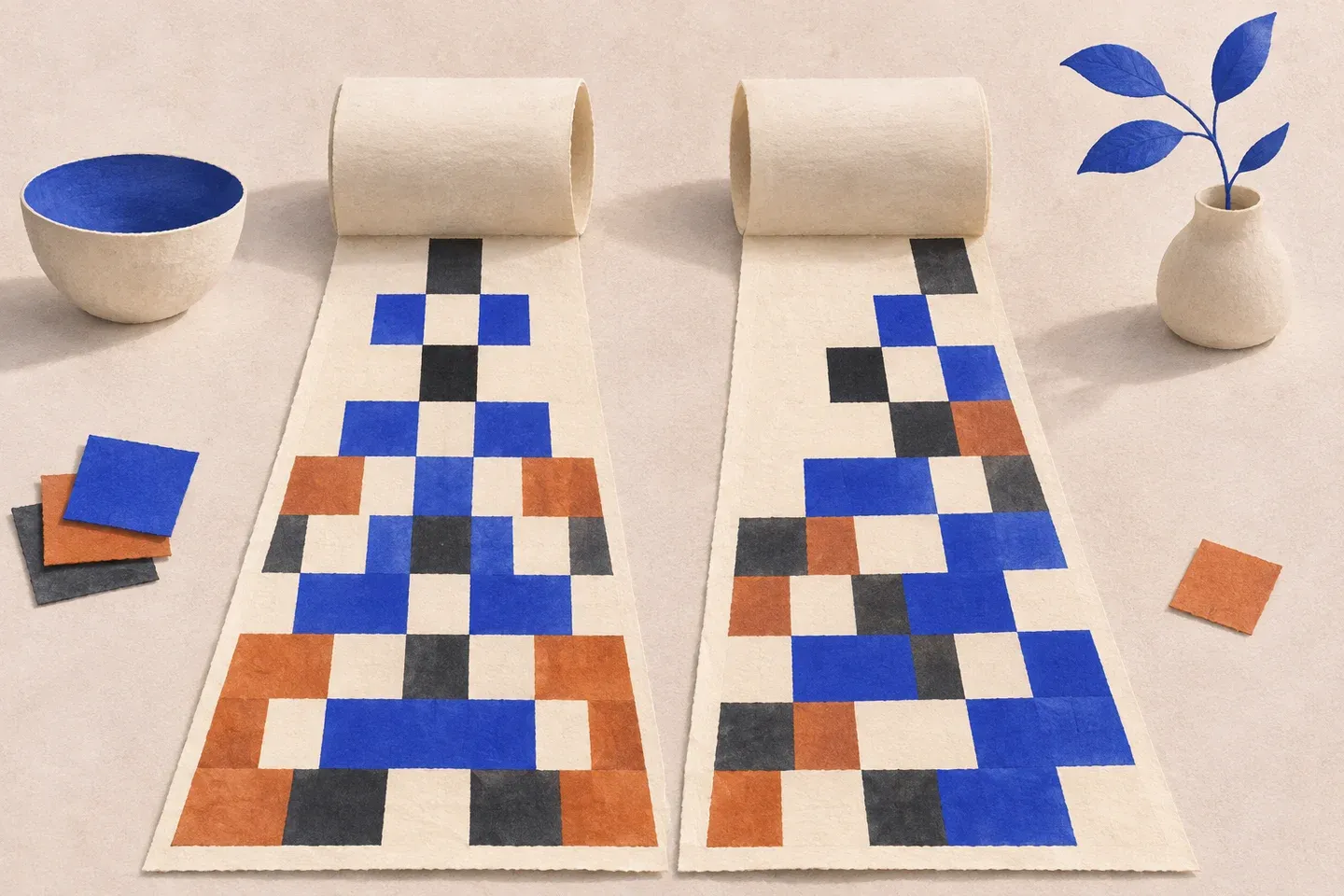
The AI-generated illustrations speak of rules and initial conditions metaphorically. Their mosaics are not rule 30 results. The mathematical evidence is the calculated grid and its list of states: confusing the two roles would make the image more evocative and the workshop less controllable.
The boundary is a decision too
Forty-one cells are not an infinite line. We chose to treat everything beyond the ends as inactive. The two boundaries could be connected, as if the row formed a ring; we could start from a different group of cells. These variations deserve their own comparisons because they change the system’s conditions.
Here I kept a single initial condition to avoid mixing questions. Within the twenty observed steps, the pattern expands to the row’s ends. Continuing without discussing its boundaries would bring a new constraint into the pattern we are reading. Reproducibility therefore requires an explicit limit to the comparison too.
The pattern does not absolve the rule
An unexpected result can be interesting, but visual interest does not prove that the rules are good for every use. In a composition we can choose a system for the variety it produces. In a process distributing resources or deciding access, we would also need to judge what its outputs entail, for whom and with which opportunities for correction.
Describing a rule does not mean judging all its consequences. The workshop leaves a small, concrete responsibility: before admiring the pattern, preserve a way to reconstruct it. That trace lets us move from surprise to a design question.