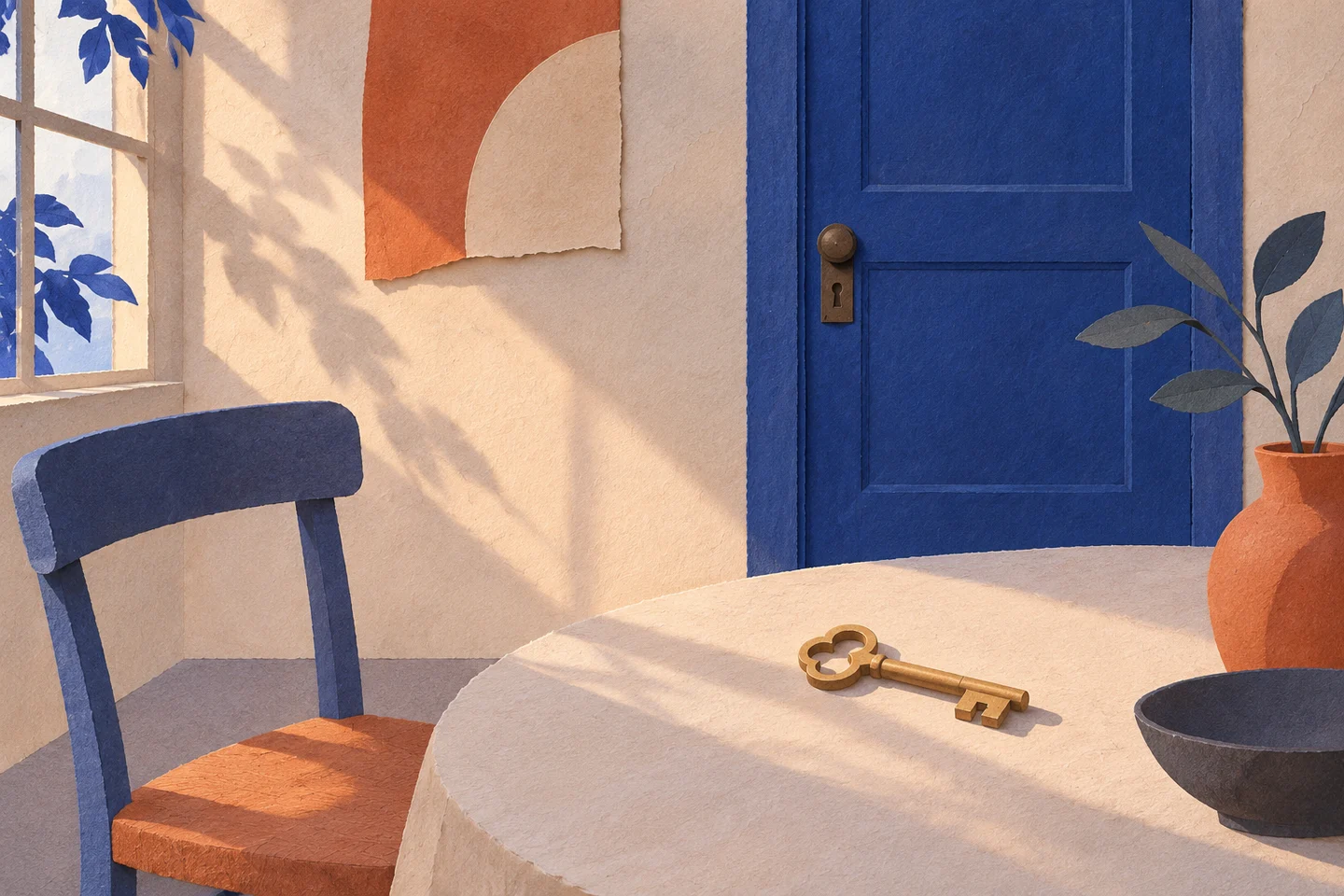
A key on a table does not yet tell us who left it. It may be ready for departure, forgotten or returned. Its presence opens possibilities that the next image may narrow. It is a small beginning, concrete enough to look at and incomplete enough to ask for a continuation.
For this notebook I constructed five imaginary views. They come from no lived episode or footage of a real place. They are original drawings of a key, a table, a door and a chair, prepared to examine how an object can hold a narrative route together.
A detail waiting for surroundings
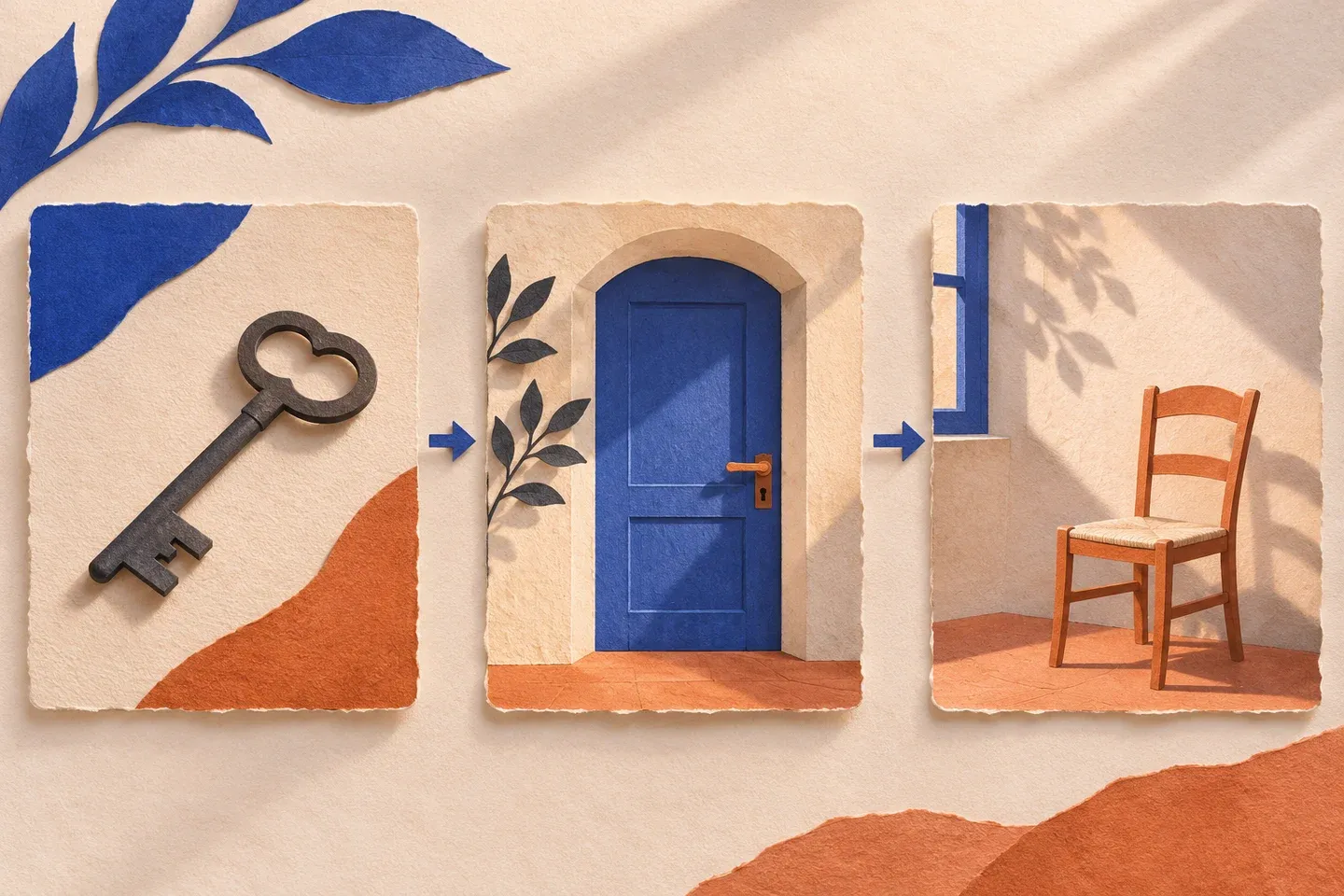
The first view isolates the key. The others widen the space, show a door ajar, place a chair near the threshold and return attention to the object. The reader can compare the initial order with a version showing the place before the detail.
Five views, two orders
Initial order
Key detail Space around the table Door ajar Chair at the threshold Return to the key
Alternative order
Space around the table Key detail Chair at the threshold Door ajar Return to the key
In the first sequence, the key is a question for which we seek a place. In the other, it is a detail within a space we have already begun to recognise. Individual views retain their content, but what each receives from the preceding one changes.
An object becomes narrative when what follows changes how we first looked at it. If every new image only confirms that the key matters, the route risks becoming a series of underlinings. It needs a relationship that makes its presence less obvious.
A chair out of place
The storyboard’s chair beside the threshold suggests a use of space without showing a person. It might have been moved to wait, or to obstruct passage. Neither explanation is a documented fact: they are possibilities offered by a fictional construction.
The difference between possibility and information helps decide what follows too. To tell a story of returning something, I would need to introduce a feature distinguishing it from abandonment. Leaving every reading equally open creates an atmosphere; that may be a choice, but it is not an already completed progression.
An object can bear considerable emphasis before it stops seeming everyday. Moving too close, lighting it like a clue and returning to it continuously may oblige the story to keep a promise it has not yet formulated. I prefer asking what each return adds, rather than treating detail as an automatic guarantee of depth.
Changing order, keeping materials
The sample keeps all five views available. Reordering adds no events and animates no hand absent from the drawings. The AI-generated illustrations accompany key, door and empty place: a second visual register for the same question, rather than frames from a filmed scene.
The comparison is limited to the image sequence. Editing with durations, sound and camera movement would introduce other decisions, to be kept separate if we wanted to understand their contribution. Here it is enough to observe which question remains open when a new view arrives.
A story can begin with a thing, but it proceeds through the relationships that thing makes necessary. The key stays on the table. What we have seen around it makes us ask, at the end, whether that place still belongs to it.