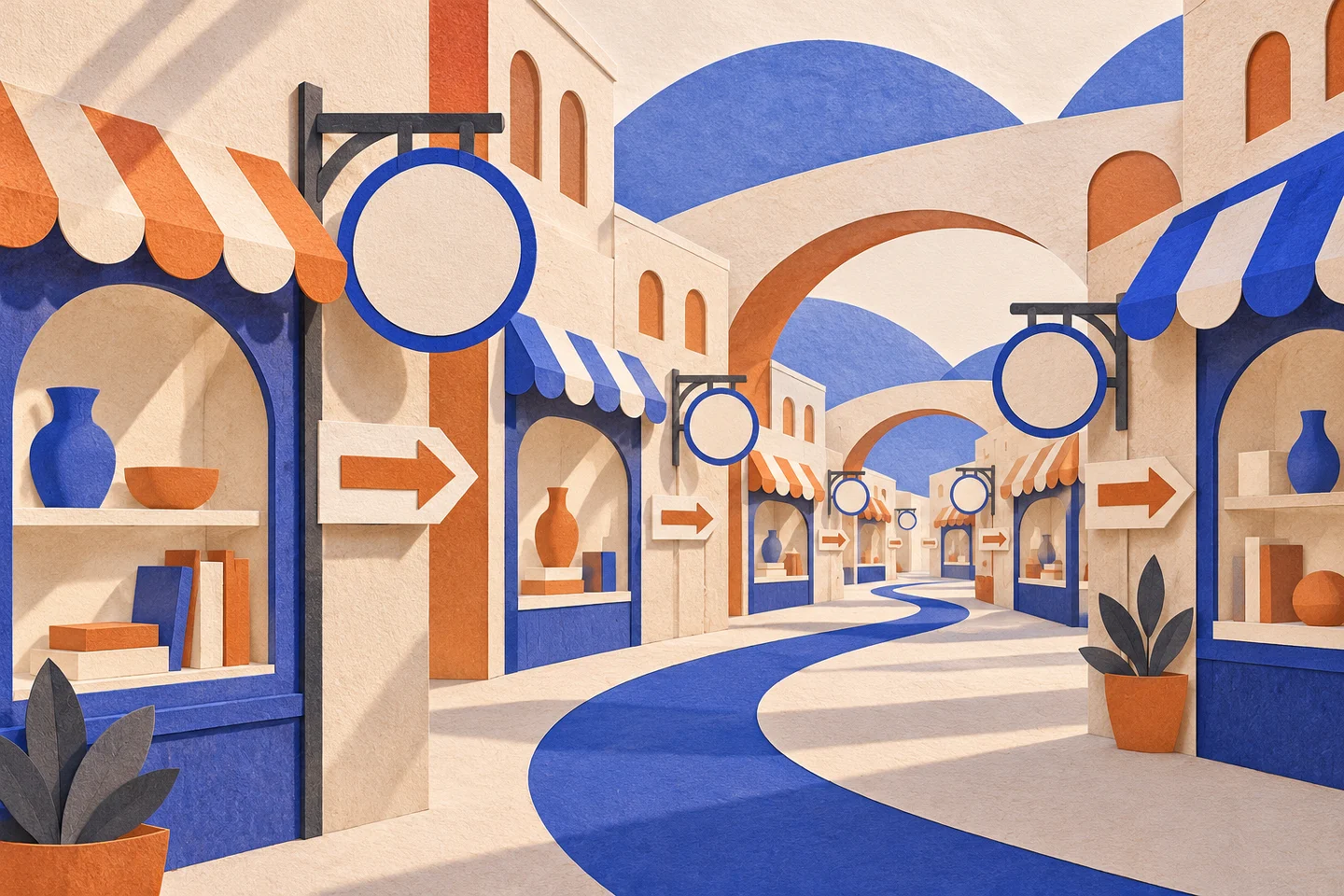
An arrow returns on a sign, in a shop window, above a door. The shape repeats, but each time asks for something different: continue, enter, choose a direction. Bringing it into a shared board produces a resemblance that could remain scattered in the street.
This notebook starts from an imaginary city. Its illustrations are AI-generated and its inventory is constructed for the page: they document no walk in Cagliari or elsewhere. This lets us discuss collecting methods without assigning the images we happen to need to an actual city.
Six motifs and two arrangements
I prepared six invented signs: three circular motifs, two arrows and a rectangle. The board collects them first by shape, then by their imagined function in the scene. The second arrangement includes invitations, directions and prohibitions; none of these signs should be used as an actual road instruction.
Six signs from an imaginary city
Inventory of an imaginary city, without references to real places.
By shape
M1 · Circle · Invitation
M2 · Circle · Direction
M3 · Circle · Prohibition
M4 · Arrow · Direction
M5 · Arrow · Prohibition
M6 · Rectangle · Invitation
By function
M1 · Circle · Invitation
M6 · Rectangle · Invitation
M2 · Circle · Direction
M4 · Arrow · Direction
M3 · Circle · Prohibition
M5 · Arrow · Prohibition
The difference between the arrangements reveals a collector’s decision. Looking for circles separates an element from its surroundings. Looking for ways of orienting people may bring together shapes with little resemblance. The board does more than preserve what I saw: it constructs a question the materials can answer.
A recurrence takes shape partly through the criterion used to seek it. This does not make it arbitrary, but it does require preserving that criterion. Otherwise the result appears to describe a place spontaneously while mainly describing the habit of our gaze.
The edge of the inventory
In a real collection I would keep a contextual view, a date and a location reference beside each detail. A letter photographed close up can look monumental; the same sign placed back above a small door returns to a relationship with the façade and people passing by.
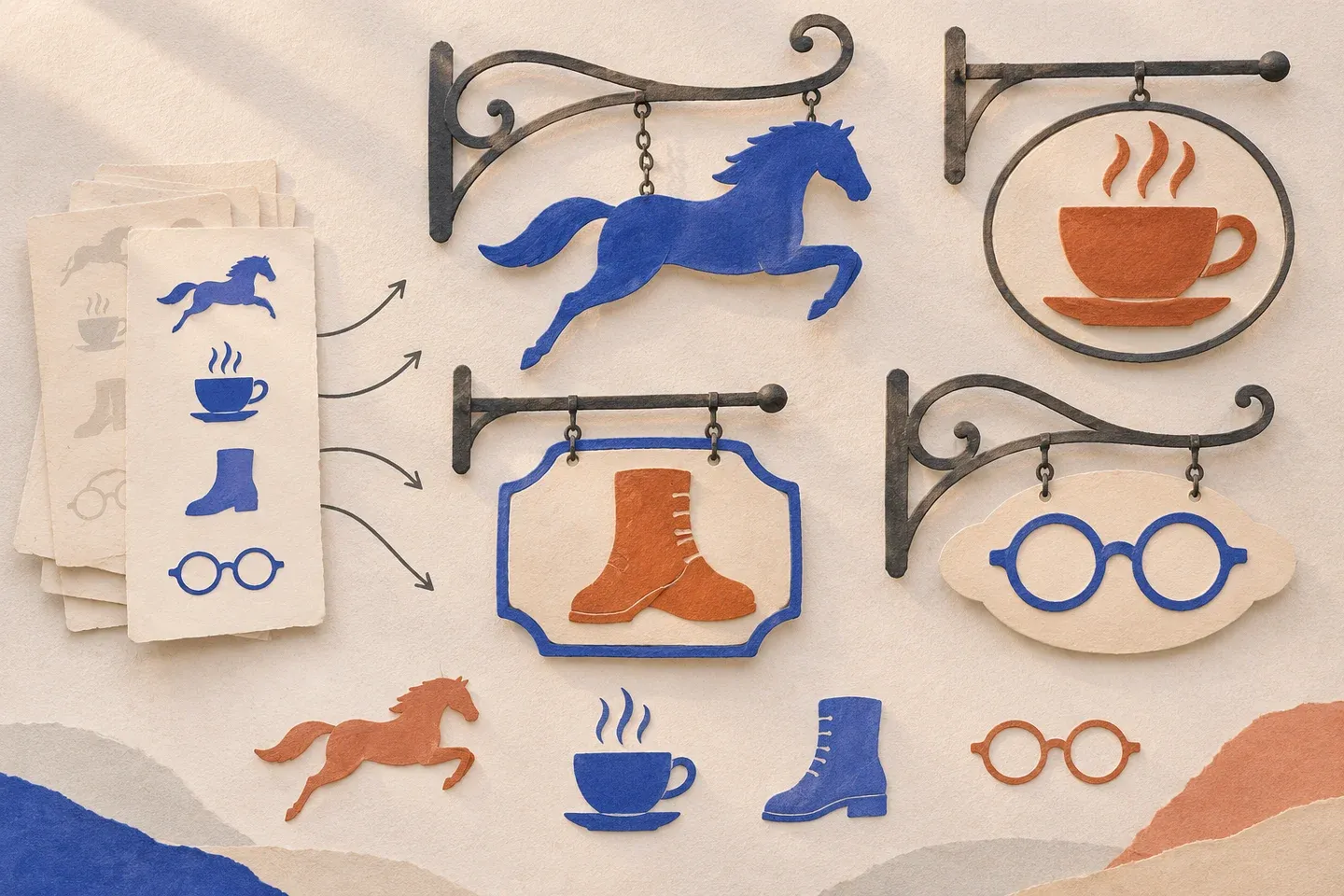
I would also retain cases that interrupt the series. A repaired sign, a new support beneath an old mark or an arrow towards a closed entrance can prevent the inventory from becoming too elegant. A city has no obligation to maintain the coherence a graphic board would like to find in it.
The route also conditions the sample. Looking only in commercial streets produces different materials from looking at courtyards, stops or residential edges. A short survey can support a precise note. It cannot summarise an entire city’s visual character.
Returning from the sign to the place
In the illustrations, the paper-built street and collected motifs show two stages of work: encountering signs in relation and separating them for comparison. Neither image certifies how frequently a motif occurs in a neighbourhood.
For a future photographic report, the board would be only one stage. I would return to the places where signs were collected and ask what classification left outside. A circle might remain unchanged while the business using it changed names; two different signs might continue doing the same job.
An inventory gains depth when it can return details to their surroundings. The arrow found again on the board may then take us back to a door, rather than persuade us that every door in that city already pointed the same way.