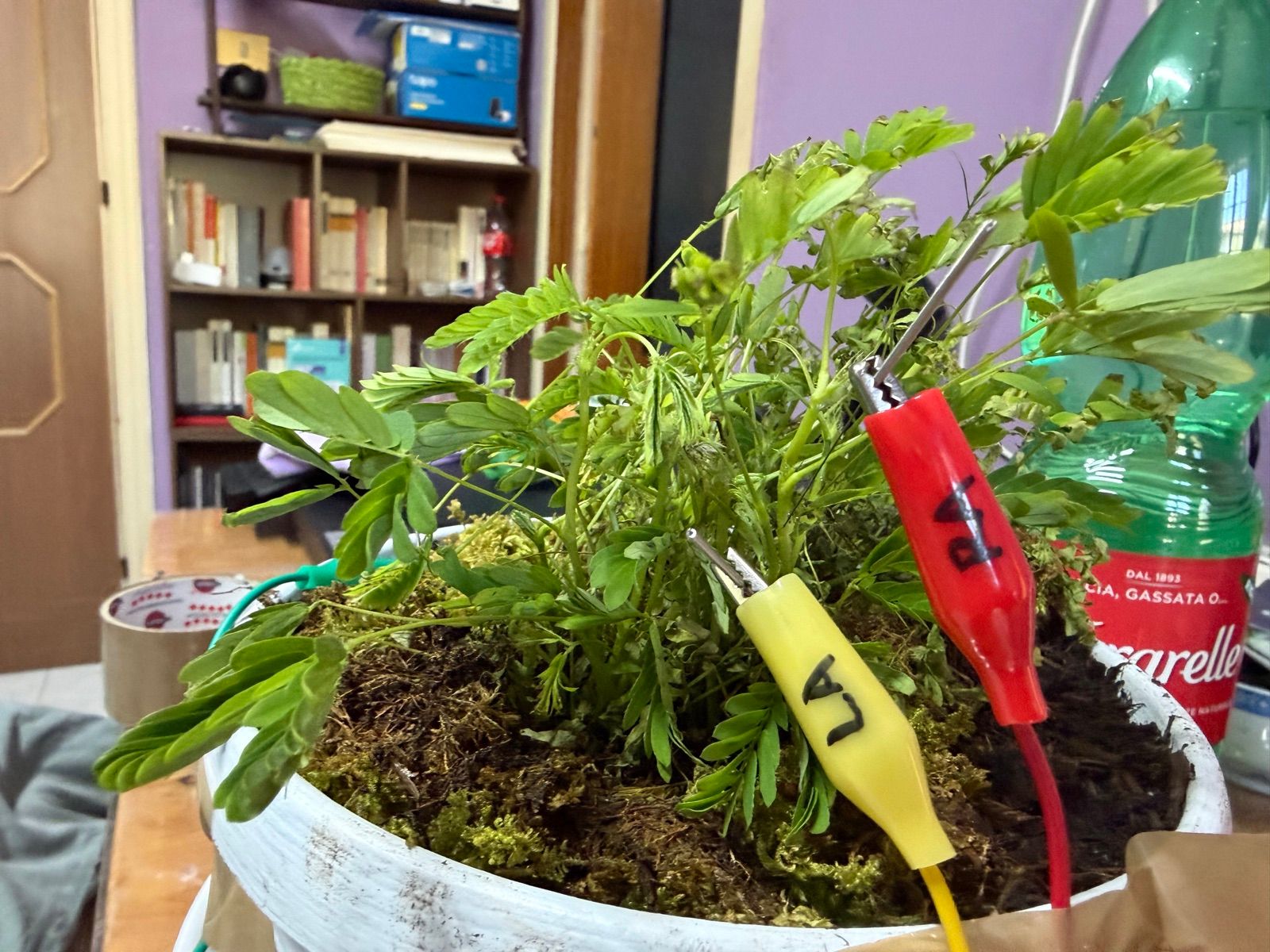
The cables are clearly visible in the photograph. The coloured clips, the pot, the leaves: put them together and we begin to expect a response. The electrical connection seems to promise access to something that, a moment earlier, was beyond our reach. If a curve appeared on the screen, we would already know where to look for its meaning.
This expectation also concerns the person building the device. In The Blind Gardeners, I connected a plant to a generative system: the acquired values enter the rules by which digital organisms change, while the audience takes part in their selection. The connection is real. That is precisely why it is worth following what happens along the cables before leaving the final image to explain it.
Waiting for a voice
A plant connected to a machine can attract attention that the pot alone struggles to receive. We stop because something seems to be happening between two worlds to which we grant different rhythms and abilities. Technology provides a familiar expectation: an input, some processing, a response. The living organism makes the content uncertain.
From here, it is a short step to saying that the plant is speaking. The word offers a familiar relationship, with a sender, a message and someone willing to listen. But we built the rules that turn values into images. When a form grows, breaks off or disappears, its visual presence can make us forget how much work went into making it possible.
This does not exhaust the interest of the encounter. A living organism can participate in a process without becoming an interlocutor shaped around our habits. Immediately asking what it wants to tell us risks narrowing what we are willing to observe: its difference interests us for as long as we can make it resemble ourselves.
What contact makes available
Electrical activity in plants belongs to physiology before it belongs to the imagery of installations. In the case of Mimosa pudica, a study by Hagihara and colleagues linked electrical signals, changes in cellular calcium and rapid leaf movements, also examining their role in defence against insects. Those observations depend on an experimental apparatus and controlled comparisons. They do not allow us to recognise the same phenomenon in every oscillation picked up by an electrode. The study sets out what was observed, together with the way it was made observable.
In my device, an AD8232 circuit sits between the electrodes and the Arduino Nano ESP32 board, amplifying and filtering small bioelectrical signals. A transformation has already taken place: the digital board receives the circuit’s output, rather than an activity of the plant that has remained intact along the way. The component is designed to handle biopotentials, but using it does not certify the origin of every acquired value. The manufacturer’s documentation also describes noise handling and problems associated with electrode contact.
The point of contact, the stability of the connection and the electrical environment all form part of the measurement conditions. Interference, too, can produce a convincing curve. Its presence on the screen tells us that the system is acquiring something; further checks are needed to attribute it to the plant. A visible response, by itself, does not identify its own cause.
This caution changes the way we look at the project. The pot and the cables cease to be technical backstage details to hide as soon as the image starts working. They are part of the relationship we are staging, including the frictions that the most successful result risks erasing.
The signal arrives already selected
In the project’s firmware, sampling is set to a thousand readings per second. The message sent to the browser, by contrast, is emitted about ten times per second and contains processed values, including amplitude, variability and an estimate of the dominant frequency. The difference matters. Receiving ten messages does not mean retaining every reading taken in the meantime, and a summary value does not always allow us to reconstruct them.
Filtering makes some behaviours more legible and attenuates others. Summarising a time window allows it to be used without transferring every sample. These decisions are necessary for the system to work, but they also determine which part of the phenomenon can reach the image. When we look at the result, those decisions tend to disappear into the word “signal”.
The word seems to refer to a single thing passing through the device. In fact, we encounter different outputs and descriptions, produced in successive stages. Confusing them makes it all too easy to travel back from the final form to the plant, as if everything in between had merely transported something.
The choices become visible again when we change the question. A parameter available in the browser may be enough to vary a digital organism. Discussing the shape of an electrical event would require data and controls suited to that event. Whether a recording is adequate also depends on what we later want to claim about it.
A threshold decides what happens
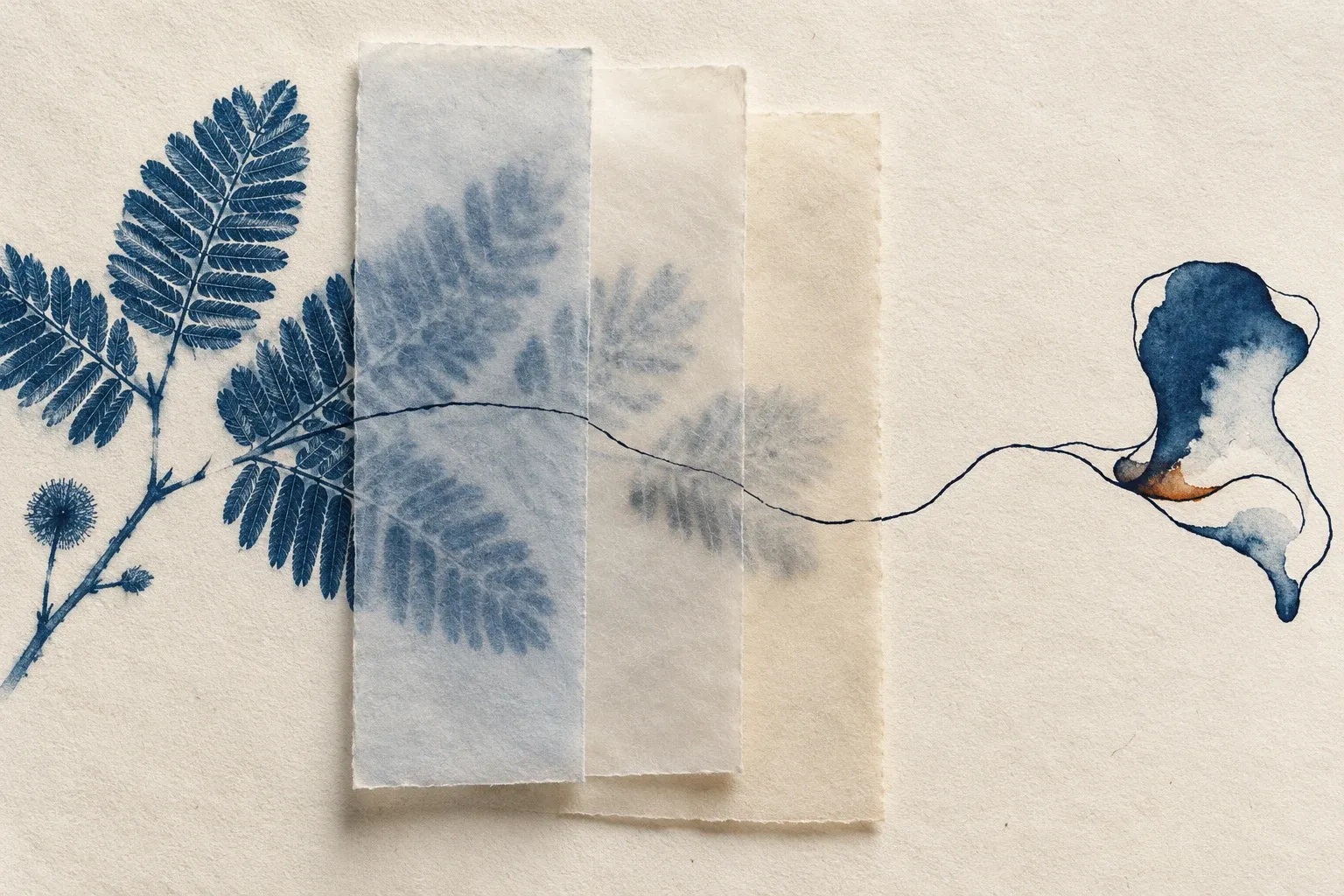
In The Blind Gardeners, amplitude contributes to changing the mutation rate of the digital population. Variability can trigger a cull; other conditions temporarily alter the automaton’s rules. This is where the acquired data is given a consequence within the work. The relationship between amplitude and mutation is a design choice: the same measurement could govern brightness, a musical interval or the speed of a movement.
The plant did not establish that correspondence. By establishing it, I take on a responsibility that the generative effect can make hard to recognise. Even when the outcome escapes me, I chose the conditions within which it can happen. Unpredictable results coexist with the precision of the rules that make them possible.
The code also brings in ambient sound, which can increase the mutation rate alongside amplitude. The environment thus participates in the transformation of forms. But once the contributions have merged into the same parameter, watching the mutation does not allow us to separate them: to do that, we have to return to the inputs, their state and how they were recorded.
The scene acquires a plurality compressed by the phrase “the plant generates the image”. There is an organism, a circuit, written rules and an environment in which those rules operate. Keeping them distinct allows us to follow the relationships the project builds, rather than attributing the whole result to its most evocative subject.
The record retains what we decided to remember
The project’s recordings also include event logs: generations, votes, extinctions and temporary rule changes. They are useful for reconstructing some of what happened. Their structure, however, serves the installation’s needs; it is not a continuous recording of the electrical measurement.
One distinction becomes particularly important when events are counted. In the code consulted, a rule change requires, among other conditions, that the estimated dominant frequency exceed a threshold. If I collect only the values associated with those changes, I have already selected a set in which the threshold was exceeded. The absence of lower values describes the criterion by which I constructed that set. It is not enough to describe the entire stream from which it came.
The misunderstanding is less conspicuous than a disconnected cable. The recording exists, the calculation may be correct and the chart may look perfectly clear; what fails is the step between the question and the data chosen to answer it. That record may be relevant to understanding the algorithm’s behaviour. On its own, it leaves the question of a physiological origin for the oscillations open.
A detailed archive can preserve, with great care, the answers to a question different from our own. Reading it again means returning to the conditions that decided which events deserved to be recorded. The device’s memory, too, has a design behind it.
The forms we choose to recognise
The audience adds another selection criterion. It can prefer a form, vote for it and let that choice influence the population’s evolution. The result therefore also depends on what is recognised, found interesting or simply noticed. Human presence enters the work’s operation through an explicit gesture, as well as through the interpretations of those watching.
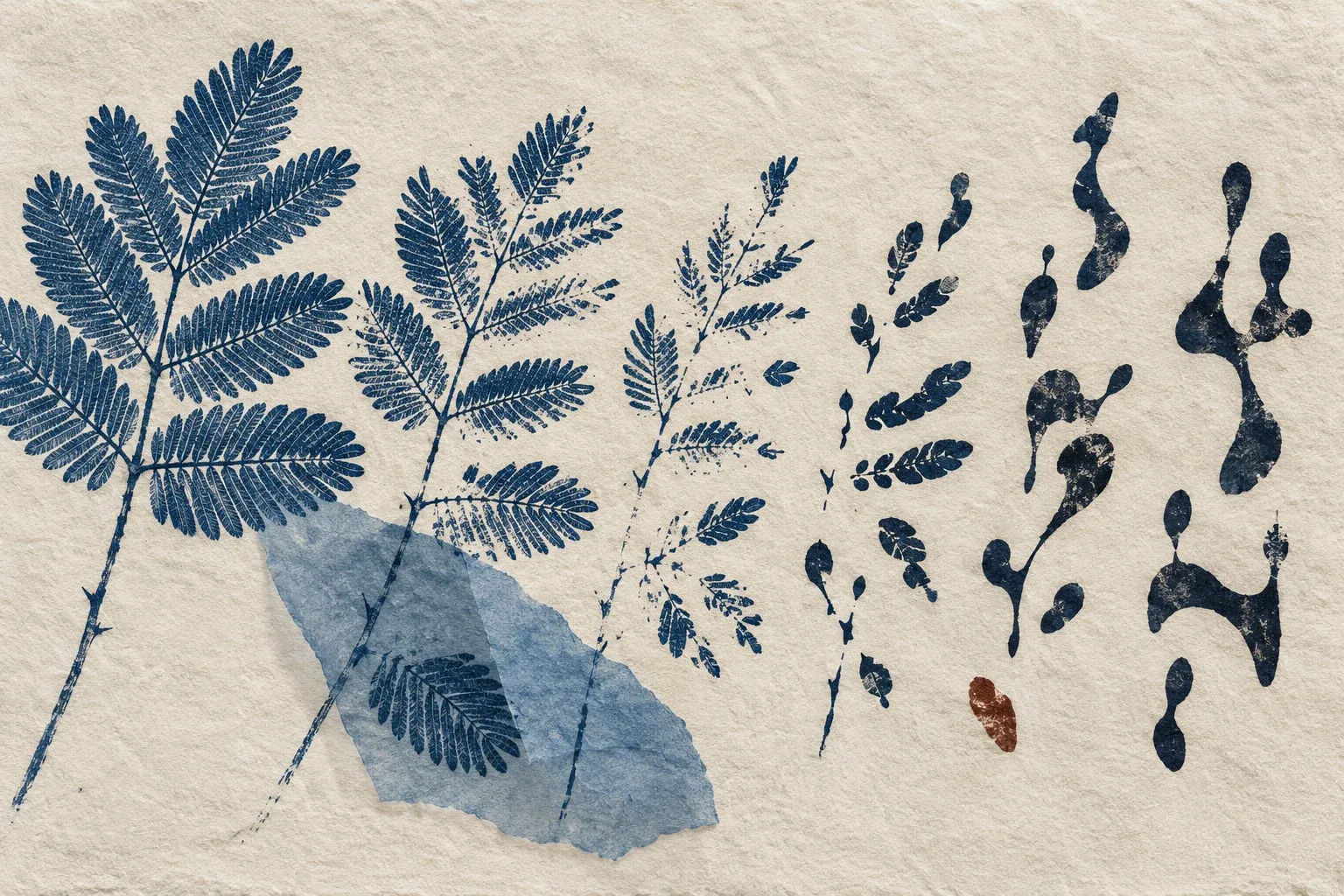
A second output of the project turns recordings into glyphs, grouping segments by similarity and deriving typographic outlines from them. The appearance of writing invites us even more directly to look for meaning. A sequence of marks can look like an alphabet awaiting its key, even when the procedure that produced it contains no translation to decipher.
The resemblance can still open up an experience. We can observe, compare and use the marks, provided the way they came into being remains recognisable. Presenting a particular set of glyphs as derived from a real recording requires tracing it back to that very recording: the existence of the procedure does not, by itself, demonstrate the provenance of every result it produces.
We return to the opening photograph. The connection between plant and machine is visible, while almost all the decisions giving it a form remain outside the frame. Following them does not remove the image’s fascination; it changes what fascinates us. We can take an interest in what happens between organisms, instruments and people without demanding that the plant confirm the story we had prepared for it.
The Blind Gardeners is documented in the project page and the repository. Biological and technical sources are linked where relevant. The text distinguishes the operation described in the code from the physiological validation of the recordings.